
Planning a Sikh wedding means capturing three to five days of sacred ceremonies, hundreds of family members, and moments steeped in centuries of tradition. Your photography checklist needs to account for the Anand Karaj’s spiritual intimacy, the Baraat’s joyful chaos, and the Milni’s heartfelt reunions, while coordinating vendor permissions, meal arrangements, and cultural protocols that differ dramatically from Western weddings.
Canadian couples planning Sikh weddings in 2026 face unique documentation challenges. The ceremony itself happens around the Guru Granth Sahib, where photographers must work unobtrusively and follow Gurdwara protocols, including head coverings and shoe removal. Natural documentation, as practiced by studios like Randhir Studios across Canada since 1991, respects these sacred spaces while capturing genuine emotion. You’re not just booking someone to take pretty pictures. You’re hiring a cultural storyteller who knows when to anticipate the bride’s maternal uncle tying the pulla, when the groom’s nephews will playfully block the entrance, and how to frame the Laavan without disrupting worshippers.
With Indian wedding photography packages starting around $5,900 for popular collections, your investment demands thorough preparation. This checklist walks you through ritual-specific shot requirements, vendor coordination essentials (including feeding your creative team and securing proper permissions), and the family photo lists that prevent post-wedding regrets.
How This Checklist Was Chosen
These fifteen shots weren’t chosen randomly. Each one earned its place based on four essential criteria: the moment’s cultural and religious significance within Sikh tradition, its emotional weight for the couple and their families, its value as a legacy heirloom for future generations, and how it fits into the unique ceremonial flow that distinguishes Sikh weddings from other celebrations.
We consulted insights from established Indian wedding photographers across Canada who’ve spent decades documenting Sikh, Punjabi, and Hindu celebrations. These photographers, from studios in Brampton to teams working coast-to-coast since 1991, emphasize a natural, documentary approach that honors the sacred while capturing unscripted joy. They don’t force moments; they witness them.
What emerged was a consensus: the most essential shots balance ritual documentation with human connection. Your wedding license and vendor coordination matter practically, but photographically, it’s the Anand Karaj, the Doli farewell, and the quiet glances between chaos that transform a checklist into a story. This list reflects both reverence for tradition and recognition that the best photography happens when cultural fluency meets genuine observation.
1. The Chunni Ceremony, Honoring the Bride’s New Family
The chunni ceremony unfolds in the quiet hours before the wedding festivities begin, typically in the bride’s family home where mothers, aunts, and sisters gather in a circle of love and tradition. The groom’s mother steps forward, draping a vibrant red or pink chunni over the bride’s head, a gesture that speaks volumes without words, welcoming her daughter-in-law into the family’s embrace.
This intimate moment carries profound emotional weight. You’ll often catch tears streaming down cheeks, nervous smiles transforming into genuine warmth, and the bride’s posture shifting as she accepts this new identity. The exchange of gifts follows: jewelry, sweets, clothing, each item a tangible promise of belonging.
For photographers, the challenge lies in the indoor setting. Natural window light works beautifully if available, casting soft shadows across the bride’s face as the chunni settles on her shoulders. Position yourself to capture both the groom’s mother’s tender expression and the bride’s reaction simultaneously. The fabric itself, embroidered silk catching the light, tassels brushing against gold jewelry, deserves close-up attention. These quiet, unposed seconds reveal the真心 heart of family bonds forming.
2. Jaggo Celebrations, The Joyful Procession
The Jaggo ceremony transforms quiet Canadian streets into an explosion of color, music, and uninhibited joy as family members dance through neighborhoods carrying brass pots adorned with candles and flowers. Capturing this procession demands anticipation and movement, your lens needs to freeze the swirling dupattas, jumping relatives, and that infectious energy that makes strangers step onto their porches to watch. The challenge lies in balancing motion with sharp focus as dancers circle and the light shifts from streetlamps to flickering candles.
What makes Canadian Jaggo celebrations visually distinct is the backdrop: tree-lined Brampton streets at dusk, Vancouver’s suburban driveways framed by mountains, or Toronto neighborhoods where the traditional Punjabi dhol echoes between modern homes. Shoot wide to capture the full procession against these settings, then move close for expressions of pure celebration, grandmothers laughing mid-spin, children mimicking the adults, the bride’s sister leading the charge. These aren’t posed moments. They’re raw, joyful chaos that tells the story of two families already merging through shared celebration.
3. Mendhi Application, Intricate Art and Laughter
The Mendhi ceremony transforms hands into living art, and your photographer should capture both the meticulous henna patterns and the intimate atmosphere that surrounds them. Close-up detail shots reveal the intricate paisley swirls, delicate peacock designs, and hidden initials woven into the bride’s palms and forearms, images that become treasured keepsakes as the henna fades but the marriage endures.
Beyond the artistry itself, this gathering pulses with female connection. Aunties share marriage advice while younger cousins giggle over their own simpler designs. The bride sits centered in the chaos, hands extended, vulnerable and celebrated simultaneously. Natural photographers who document weddings without forcing moments know to step back during these hours, letting the laughter and storytelling unfold authentically. Catch the concentration on the mehndiwali’s face as she steadies her cone, the bride’s profile softened by afternoon light, and the worn hands of grandmothers resting beside newly decorated ones, three generations linked through tradition and love.
4. The Sehra Bandi, Preparing the Groom
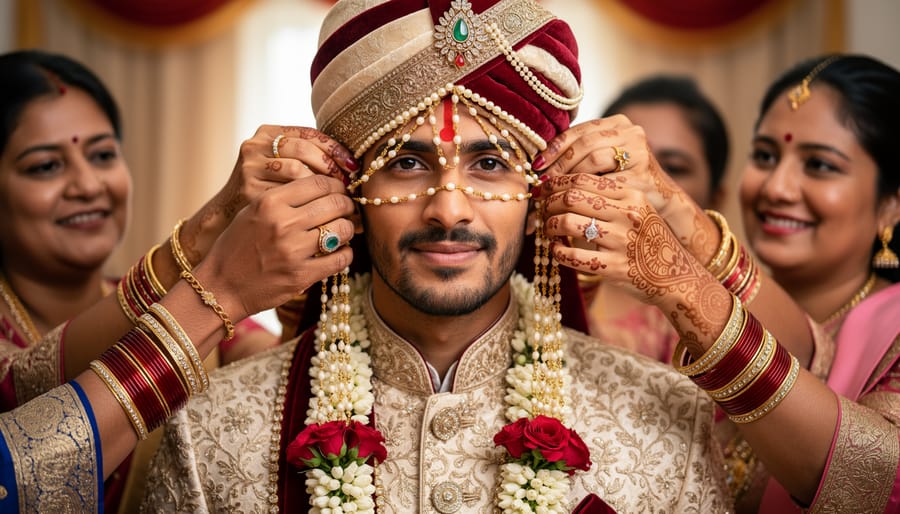
The sehra bandi unfolds in a closed circle of men, fathers, brothers, uncles, and closest friends, gathering around the groom in a quiet room before the baraat. His father or eldest male relative ties the sehra, a delicate veil of marigolds, roses, and jasmine that cascades down to shield the groom’s face from evil spirits and mark his final moments as a son. The ritual carries profound weight: hands that once steadied a boy’s first steps now prepare him to lead his own family.
Capture the father’s expression as he adjusts the floral strings, the groom’s steady breathing beneath the veil, and the uncles who step forward to bless his forehead. These are the male-bonding moments, quiet pride, whispered advice, shoulders gripped in reassurance, that contrast with the coming spectacle of the baraat. Photograph the sehra itself in detail: its construction, the way light filters through petals, and how it transforms the groom’s silhouette. This intimate preparation, often overlooked in favor of louder celebrations, reveals the emotional core of his transition.
5. Baraat Arrival, The Groom’s Grand Entrance
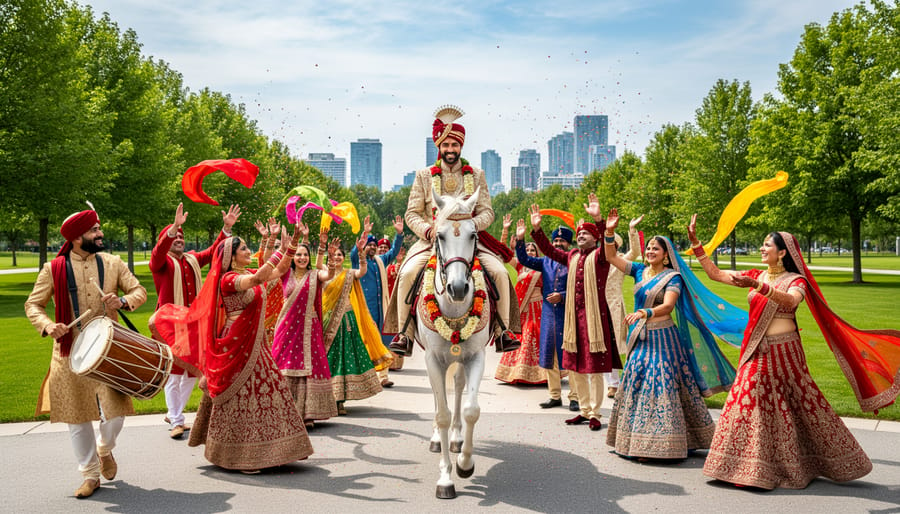
The Baraat transforms a wedding procession into pure celebration. Picture the groom arriving on a white horse, or sometimes in a vintage car, decorated float, or even a Harley-Davidson, while his family and friends dance through the streets in waves of color and music. Dhol drummers set the rhythm as uncles loosen their ties and cousins break into bhangra moves, creating the kind of unscripted joy that photographs itself.
Canadian settings add their own drama to this moment. A Baraat winding through Vancouver’s tree-lined neighborhoods with mountain peaks in the distance, or arriving at an Ontario estate where fall leaves frame the dancing procession, becomes uniquely memorable. The energy shifts constantly: one moment capturing the groom’s nervous smile beneath his sehra, the next freezing a grandmother mid-dance, dupatta flying.
Photographers who document weddings naturally know to position themselves ahead of the procession, shooting back toward the advancing crowd to capture faces lit with excitement. The chaos contains the story, sweating foreheads, shared flasks, the moment when the bride’s family finally spots the approaching celebration and rushes forward to greet it.
6. Milni Ceremony, Two Families Become One
The Milni marks the first formal meeting between the two families, transforming separate households into one extended clan. Corresponding male relatives from each side, fathers, uncles, brothers, grandfathers, embrace in pairs while garlands are exchanged and monetary gifts are often presented. These aren’t quick handshakes; they’re meaningful embraces between men who may be meeting for the first time yet are now bound by this union.
Photographing each pairing individually is essential. The groom’s father embracing the bride’s father carries profound weight, as do the uncles, the eldest brothers, and sometimes cousins. Watch for the lingering moments after the formal embrace, the whispered words, the hands that linger on shoulders, the tears that slip down faces when generations bridge the gap between families.
Position yourself to capture both faces during each embrace, the expressions of witnesses in the background, and the generational layers as grandfathers steady themselves while younger relatives wait their turn. Create a family photo list beforehand noting key relatives so no pairing goes undocumented. These images become visual proof of the moment two lineages merged into one shared story.
7. The Bride’s Entrance to the Gurdwara
The bride’s entrance to the Gurdwara marks a profound spiritual threshold, her final steps as her father’s daughter before becoming a wife. Traditionally, her maternal uncle or brothers escort her through the doors, their supportive presence honoring both her past and her future. This moment carries a reverence you can feel in the hushed anticipation: heads covered, shoes removed, the scent of incense welcoming her into sacred space.
Photographically, capture her face as she crosses that boundary, the downcast eyes, the steadying breath, the weight of tradition settling across her shoulders. Frame the doorway to show the transition from outside light into the Gurdwara’s sanctity. Notice how her dupatta drapes, how her hands might clasp her uncle’s arm, how family members pause to watch. These quiet seconds before the ceremony begins tell a story of faith, family, and the irreversible beauty of commitment. Respect the space’s protocols while documenting this tender, transformative entrance.
8. Anand Karaj, The Four Lavaan Circles
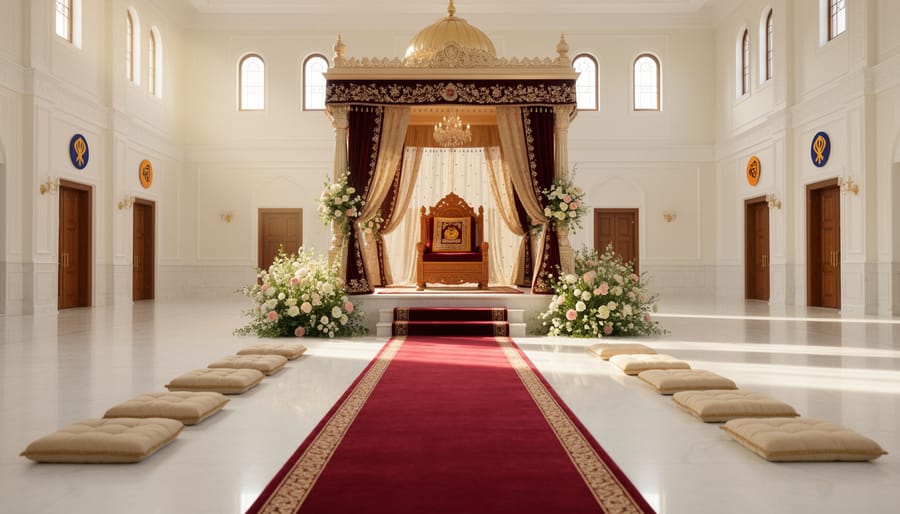
The Anand Karaj ceremony represents the spiritual heart of a Sikh wedding, where the couple circles the Guru Granth Sahib four times while Lavan hymns are recited. Each circumambulation marks a progressive stage of the soul’s union with the divine, from duty and commitment through devotion and ultimate spiritual harmony. Your photographer must capture the couple walking clockwise together, the bride following the groom’s lead, their heads covered in reverence as family members often support the bride’s dupatta or hold her hand.
The key is documenting each lavaan without disrupting the sanctity of the space. Respectful photographers position themselves discreetly, using natural light to frame the couple’s bowed heads, joined hands, and the reverent expressions of seated family members witnessing this sacred covenant. Wide shots establish the Gurdwara’s spiritual atmosphere, the decorated canopy, the Guru Granth Sahib elevated on its manji, the raagi musicians, while tighter compositions capture tears on parents’ faces and the couple’s quiet devotion as they complete their journey around the scripture that now binds their marriage.
9. Rumala Sahib Presentation, Offering to the Guru Granth Sahib
The Rumala Sahib presentation stands among the most spiritually significant moments to photograph during a Sikh wedding. This offering of the ceremonial cloth to cover the Guru Granth Sahib represents the couple’s first act of devotion as partners, acknowledging the sacred wisdom that just bound them together.
The visual power lies in the couple’s posture: heads bowed in reverence, hands joined together as they present the beautifully embroidered fabric. Their profiles create a frame of humility and gratitude that tells the story without needing their faces fully visible. The colors and craftsmanship of the Rumala itself, often gold-threaded silk in deep burgundies, royal blues, or rich saffrons, add cultural richness to the frame.
Photographers who document weddings naturally understand that this isn’t a moment to interrupt or direct. Position yourself to capture the offering from an angle that shows both the couple’s reverence and the Guru Granth Sahib’s honored placement, respecting Gurdwara protocols while preserving this gesture of faith. The quiet intimacy of this act, surrounded by family and community, becomes a touchstone image that reminds couples of the spiritual foundation beneath their celebration.
10. The Couple’s First Moments as Married Partners
The ceremony concludes, the fourth lavaan complete, and suddenly they’re married. This is the moment, not the posed portraits that will come later, but the unguarded seconds immediately after. The groom’s hand finding the bride’s. Her shoulders releasing tension she didn’t know she’d been holding. Tears streaming freely down both their faces, or laughter bubbling up unexpectedly. Sometimes it’s a whispered “we did it” that no one else hears. Your photographer should be watching for these unrehearsed reactions, the ones that reveal what this commitment actually means to both of you, whether you’re celebrating in a grand ballroom covered in our Canada venue guide or an intimate Gurdwara ceremony. These frames matter more than perfect lighting or formal composition, they capture the weight of the vows settling, the joy breaking through, the profound recognition that everything just changed.
11. Doli Ceremony, The Emotional Farewell
The Doli ceremony marks one of the most emotionally charged moments in a Sikh wedding, the bride’s departure from her childhood home. As she leaves with her new husband, family members shower her with rice, symbolizing blessings and prosperity, while tears flow freely from parents, siblings, and grandparents who’ve watched her grow. Your photographer needs to capture the raw, unfiltered emotion: mothers wiping tears, fathers struggling to maintain composure, and the bride herself navigating the bittersweet transition between daughter and wife. These images carry multi-generational weight, echoing the same farewell her mother, grandmother, and ancestors experienced. Look for photographers who can master portraits that honor both the individual grief and collective joy of this profound tradition, documenting embraces, whispered blessings, and that final backward glance before she crosses the threshold into her new life.
12. Reception Grand Entrance, Celebrating as Newlyweds
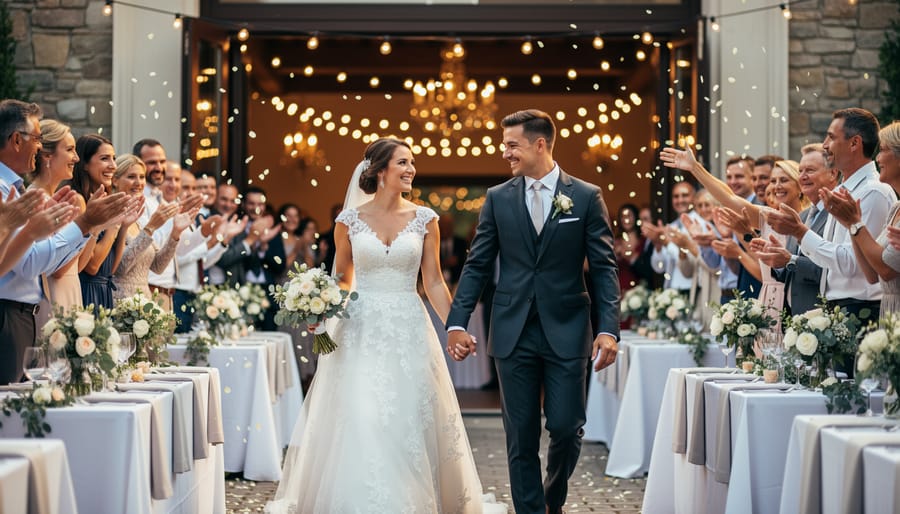
The reception grand entrance marks the first time your guests see you as husband and wife, transforming months of anticipation into pure celebration. This moment deserves photography that captures the explosive energy, coordinated bhangra dances, dramatic lighting effects sweeping across the venue, and the joy radiating from both families finally united. Your photographer should position themselves to frame both your entrance and the crowd’s reaction, whether you’re walking into a glittering urban ballroom in downtown Toronto or a lakeside estate venue overlooking the Okanagan.
This entrance often showcases the same vibrant colors and textures as your ceremony, sometimes incorporating family heirlooms like your grandmother’s dupatta or the groom’s ancestral turban. The best shots balance the choreographed elements, smoke machines, spotlight introductions, synchronized dance moves, with genuine reactions: your mother’s tears, your best friend’s laughter, the moment you lock eyes with each other amidst the chaos and realize you’ve actually done it.
13. Family Portrait Combinations, Legacy and Lineage
Sikh weddings honor extended family in ways that western traditions rarely match. Your family portrait list isn’t just a courtesy, it’s a legacy document that generations will return to, studying the faces of grandparents, tracing lineage, and remembering who stood witness to this sacred union. Creating a detailed shot list before the wedding prevents chaos during group photos and ensures no one is forgotten in the celebration’s rush.
The essential combinations to capture include:
- Both families together, the complete merged lineage
- Each side separately, bride’s family, then groom’s family
- Generational portraits, all grandparents, all parents, all cousins
- Siblings only with the couple
- Grandparents with the couple, often the most treasured image
- Parents with the couple from both sides
- Extended family by branch, paternal and maternal lines
Work with your photographer to sequence these groupings logically, keeping elderly relatives comfortable and moving efficiently through configurations. Consider incorporating environmental portraits that use your venue’s architecture or Canada’s landscapes as backdrops, creating images that feel less staged and more authentic to your celebration’s spirit.
14. Cultural Details, The Colors, Textures, and Traditions
The embroidery on a bride’s dupatta carries generations of craftsmanship. Gold jewelry reflects candlelight during the Anand Karaj. A groom’s kara catches the moment he places his hand over his bride’s. These aren’t just accessories, they’re visual chapters of your story, and capturing them requires both technical precision and cultural understanding.
Your photographer should document the Guru Granth Sahib’s ornate rumala coverings, the intricate henna patterns spiraling up the bride’s forearms, the vibrant silk of perfectly tied turbans, and ceremonial kirpans representing courage and honor. Close-up shots of these textures and colors become the connective tissue between your wedding album’s larger moments, grounding the narrative in authentic tradition.
Consider how natural light plays across embroidered fabrics or how pro editing tips can enhance the richness of jewel tones without losing their authenticity. The best detail shots don’t feel staged, they’re discovered in quiet seconds between ceremonies, when your grandmother adjusts your mother’s shawl or your father straightens his turban before walking you down the aisle. These fragments become the visual poetry that makes your album distinctly yours.
15. Candid Moments Between the Chaos, The Unscripted Love
Between the choreographed ceremonies and formal family groupings, Sikh weddings pulse with moments no timeline can predict. A groom steadying his bride’s hand as she steps over the threshold. Siblings whispering encouragement before the Anand Karaj begins. A grandmother dabbing tears during the Doli, her face softening with pride and memory. These unscripted fragments, the quiet laughter shared during a chaotic Baraat, the way a couple’s eyes meet across a crowded Gurdwara, reveal the genuine love story beneath the tradition. Skilled photographers recognize these fleeting exchanges and capture them without intrusion, understanding that authenticity can’t be directed or recreated. The best Sikh wedding albums balance the essential ritual documentation with these tender, honest moments that remind you why you married this person, in this way, surrounded by these people. Years later, it’s often these candid glimpses, not the posed portraits, that transport you back to the emotion of the day, the sacred chaos where two lives truly became one.
Planning Your Sikh Wedding Photography Investment
Investing in specialized Indian wedding photography for your multi-day Sikh celebration deserves careful consideration, as these images become your family’s legacy. In Canada, comprehensive coverage from photographers experienced in documenting Sikh, Punjabi, and Hindu traditions typically starts from $5,900 for full collections. This investment reflects not just technical skill but cultural fluency, photographers who understand when to capture the reverent silence during Anand Karaj and when to anticipate the explosive joy of Baraat arrivals. The best cinematic photography and videography documents your wedding naturally and beautifully without forcing moments, allowing genuine emotion to unfold while ensuring every ritual receives its proper weight.
When evaluating photographers, ask to see complete galleries from Sikh weddings they’ve documented, not just highlight reels. You want someone who respects Gurdwara protocols, knows how to work with changing light across indoor ceremonies and outdoor receptions, and brings enough experience to navigate the complex flow of a multi-day celebration without missing the grandmother wiping away tears or the groom’s nervous laughter before his first lavaan.
Regional Considerations Across Canada
Canada’s vast geography means your Sikh wedding photography needs shift dramatically by region. In Brampton and Toronto, photographers navigate densely packed celebration schedules across multiple Gurdwaras, often shooting several events in a single weekend. The concentration of South Asian vendors here creates seamless coordination, but also demands photographers who can stand out in a saturated market through genuine cultural understanding rather than just showing up with a camera.
Vancouver’s Sikh wedding photography contends with stunning mountain and ocean backdrops that can elevate portraits dramatically, though unpredictable weather requires flexible indoor-outdoor strategies. Calgary’s smaller but tight-knit Punjabi community often means photographers become extended family across multiple weddings, building trust through consistent, respectful documentation.
Choose a photographer who knows your city’s Gurdwara protocols, established vendor networks, and seasonal venue considerations. Someone who has photographed dozens of Sikh weddings at your specific Gurdwara understands lighting challenges, best angles during Anand Karaj, and which community elders to approach for permissions, practical fluency that transforms good coverage into exceptional storytelling rooted in your celebration’s unique Canadian context.
Your Wedding License and Essential Day-Of Checklist
Beyond capturing beautiful images, practical preparation ensures your Sikh wedding day flows smoothly. Start by securing your marriage license well in advance, processing times vary by province, and you’ll need it for the official ceremony. Confirm photography permissions with your Gurdwara, as each has specific protocols about where photographers can stand during the Anand Karaj and whether flash is permitted.
Create a detailed family photo list with specific groupings and distribute it to your photographer at least a week before the wedding. Without this roadmap, you risk missing essential combinations during the limited window between ceremony and reception. Coordinate meal arrangements for all vendors, photographers, videographers, and DJs need sustenance during your multi-hour celebration to maintain their energy and focus.
Your final day-of checklist should include:
- Wedding license secured and brought to the ceremony
- Vendor meal arrangements confirmed with catering
- Family photo list distributed to photographer with names and relationships
- Gurdwara photography permissions verified in writing
- Timeline shared with all vendors so everyone knows the ceremony flow
These practical steps free you to be fully present during each ritual, knowing the logistics are handled and your photographer understands exactly which family connections matter most to your legacy.
Common Questions About Sikh Wedding Photography
Photographing a Sikh wedding requires both technical expertise and cultural sensitivity. Most couples hiring specialized photographers have practical questions about how the day will unfold, what permissions are required, and how to ensure their multi-day celebration is captured authentically.
What permissions are needed to photograph inside a Gurdwara?
Each Gurdwara has its own photography policies, so contact the management well in advance to understand their specific guidelines. Most allow photography but require respectful coverage that doesn’t disrupt worship, and photographers must cover their heads and remove shoes like all other guests.
How many photographers should I hire for a multi-day Sikh wedding?
Two photographers work best for capturing different angles during ceremonies like the Anand Karaj, covering both the couple and family reactions simultaneously. For large Baraat processions or receptions with 300-plus guests, a second shooter ensures no moment is missed.
Is flash photography allowed during the ceremony?
Many Gurdwaras restrict or prohibit flash photography during the Anand Karaj to maintain the sacred atmosphere. Professional photographers experienced with Sikh weddings use high-quality cameras capable of capturing beautiful images in natural or ambient light.
How do you balance traditional family portraits with creative, candid shots?
The best approach dedicates specific time blocks for formal family groupings, using that detailed family photo list, while documenting the rest of the celebration naturally. Photographers who specialize in South Asian weddings know how to capture cultural traditions authentically without staging or forcing moments.
When choosing your photographer, look for someone who documents weddings naturally and beautifully, understanding both the flow of Sikh ceremonies and the emotional significance behind each ritual. Photographers established in Canadian South Asian communities, particularly in areas like Brampton and Toronto, often bring valuable relationships with local Gurdwaras and venues alongside their cultural fluency.
Your Sikh wedding is a sacred celebration woven through with centuries of tradition, yet every laugh, tear, and whispered promise is uniquely yours. These 15 essential shots form the foundation of your visual legacy, but the photographer you choose will determine how that story is told, whether it’s stiff and posed or alive with the genuine emotion that defines your family’s love.
Look for someone who moves through your celebration with both reverence and ease, someone who understands the spiritual weight of the Anand Karaj and the chaotic joy of the Baraat, who can capture your grandmother’s blessing and your best friend’s reaction with equal care. Whether your ceremonies unfold in a prairie Gurdwara or against the backdrop of mountain venues, the right photographer sees beyond the checklist to the hearts beating through every ritual.
This is your heritage meeting your future, your families becoming one, your love story beginning its next chapter. Choose someone who honors all of it.